Believe it or not, the idea of wearable technology has been around for centuries. In fact, the Chinese invented the abacus ring, a precursor to modern-day wearables, back in the 17th century to allow mathematicians to compute figures on the go. Today, the technology has evolved more than most could dream and continues to become increasingly prominent in our lives. In fact, in the industrial enterprise marketplace, it may just be the way of the future.
According to a recent survey conducted by APX Labs, the developer of Skylight (an application that connects smart glasses and smart watches to sensors, systems and data), a whopping 93% of companies in the aforementioned sector are evaluating wearables and how to leverage the technology to achieve business goals. Additional data from The State of Enterprise Wearable Adoption study shows that 87% believe that it will have a significant impact across their industry within the next five years.
How companies can benefit
Within the industrial enterprise vertical, companies reported seeing wearable technology as an opportunity to solve business problems and positively impact their employees, as well as their bottom line. This comes as no surprise, given that Gartner recently reported that smart glasses will result in $1 billion annual cost savings in the field services industry alone. From increasing task efficiency to improving safety to monitoring activity tracking to inspection quality assurance, there is a wide array of applications well-suited to the wearable space.
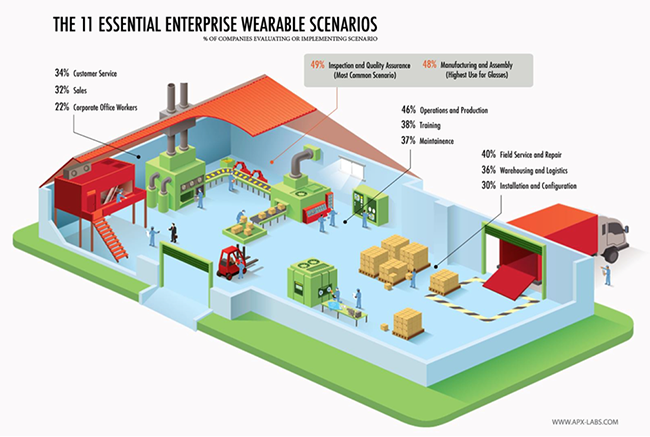
Brian Ballard, CEO and co-founder of APX Labs, summarized this by saying, “Most of the real value around it is that people are being issued this [wearable technology] at work. They’re being asked to profile the device. Compute the ROI. Inform the company about how they can maximize the value of this new technology as a tool.”
How implementation is working
The study went on to reveal that smartwatches were being used by 61% of companies and 42% were using smart glasses, while 32% of companies were using both. One of the most exciting pieces of information that came to light is that 49% of companies are currently running pilot projects or have a production deployment at hand.
Given the data and the projection from IMS Research that the wearable technology marketplace will grow to $6 billion by 2016, it may not be long before we see companies showcasing a multi-device, multi-scenario workforce. If you’re making decisions for a company within manufacturing, life sciences, transportation, oil and gas, or other similar industries, now’s the time to start making the infiltration of wearables work for you.